Friday, March 31, 2017

Sustainable Shopping?


It all began with me trying to find a word opposite of shopaholic. My husband and I have never really been big on shopping and wanted a term to describe ourselves. Turns out, there is no antonym for shopaholic; there is however a condition called “Officinaphobia” which means fear of shopping. Phobia is an extreme or irrational aversion to something. Our distaste for shopping on the other hand is moderate and quite rational.
Shopping is a difficult optimization problem for me. The following goes on in my mind when I buy things:
 Space factor: Where will I keep it? We stay in a rented 1 BHK in Mumbai and don’t have enough space for anything beyond the essential items
 Maintenance factor: How much of maintenance will the stuff require? Most things need dusting, cleaning, servicing
Cost factor: Is the purchase a value deal? Will I require it often enough to justify the purchase, will it make the task at hand easier? 
Time factor: is my time well spent researching from the ample choices. How long will the stuff last?
As is apparent from the above Venn diagram, in the universe of things, my sweet red spot is quite small.
Just yesterday, Jayesh and I went shoe shopping. Our less than 6 months old shoe had torn off and was irreparable. After spending 2 hours I managed to get a new pair for myself. Jayesh decided to use his old but functional sneakers as none of the shoes fit the problem statement he wanted to make purchase for.  
Consider the sample problem: To buy a long lasting (1.5- 2 years) pair of slip- on lace-less shoes (popularly called loafers)  that can be used for riding a motor bike and withstand the wear and tear of the foot controlled gear. 

Loafers

After scanning several stores and spending about 2 hours, we realized that such a shoe does not exist. None of the shop owners were ready to give a warranty of more than 3 months on their loafers, irrespective of the price and brand of the shoe.
What were our options?
1. Change geared bike to an automatic one
 2. Make do with the old pair sneakers with laces and learn to secure them well enough so that it does not come undone often
3.  Be a loafer who can afford the time to buy new loafers every 6 months.
We went with option 2 that did not involve any further purchase. The whole shopping –optimization- exercise left us annoyed and energy-sapped. I wish we could ‘outsource’ buying certain items to someone else: a personalized shopping aide –of- sorts. That however, may just shoot up the ‘Cost factor’!

Shopping for me is a chore and as long as it is basic essentials: grocery, vegetables, major long term purchases like fridge, washing machine, two- wheeler, I do my duty fairly well. It is when it comes to things like: clothes, cosmetics, mobile phones, or even TV that my head starts reeling and I start procrastinating. My husband and I have been postponing the decision to buy a television for 4 years now. It is not that we have not tried. The TV market seems to be in some transition; the smart TVs’ are new and the pocket friendly models all have a life span of 2-4 years. We were looking at a more long term investment which was not available. We never ended up getting a TV.  Often times we rationalize our inability of zero in on a TV as good riddance. It helps us spend more quality time together: going out, socializing, reading a book or playing board games.


My habits and expectations were shaped in the 1980's and 1990's when India was still socialist and most purchases were done with the functionality and longevity in mind. I remember buying ‘Bata shoes’ that would last forever and we were more likely to outgrow them than tear them.
I dislike the fact that things have to be replaced and bought so often. Below is a rough estimate of change in lifespan of some items, as per personal experience:

Item /Product
Life span old model   
(in years)
Life span of new model (in years)
Mobile phone

5-10

2-4 (smart phones)
 Laptop
6-8
4-6
Television
10-15
2-4 (smart TV)
Kitchen utensils like kadhai, tawa, steel plates
30-40 (passed down from generations. We still have a functional kitchen mortar that came to India with my grandmother at the time of India- Pakistan partition
2-5 years, steel has become less fashionable and replaced with melamine dishes; non-stick pans need changing every 3-5 years

Shoes/footwear

4-8
0.5-1
Text books

The editions of major text books didn’t change every year. Basics as we all know remain pretty much constant for the most part.

Every year a new edition come out which becomes mandatory to purchase. I understand there are faster advancements but not enough to generate new editions every so often. Why not make only the updated information available why make a whole new edition?

I guard my time and energy against the ‘Planned obsolescence’ that many companies have unleashed on the unsuspecting common man. Planned obsolescence is planning or designing a product with an artificially limited useful life, so it will become unfashionable or no longer functional after a certain period of time.The rationale behind the strategy is to generate long-term sales volume by reducing the time between repeat purchases. Needless to say this strategy feeds on our consumerism and is not environment friendly. While it is becoming impossible to totally stay away from it, it is still possible to be mindful of it. Maybe we can’t escape buying a new smart phone every 3 years, but we can still buy steel utensils, get servicing for the two- wheeler or car on time so that they last long.
There are pros and cons for everything, likewise for my distaste for shopping.

Cons
Pros
I am almost always out of fashion with respect to my get up.

My sister, mom, mom-in law and friends end up filing in this gap and gifting me clothes and cosmetics I would otherwise not buy. Saves me a lot of time & money

My house always ends up looking like a bachelor pad.

It is always easy to relocate, whenever my husband’s job beckons a geography change.
Easy to clean up

Gives me idle time, most of which is spent
worrying unnecessarily
Gives me time to write blogs like this one ;)

If enough number of people ‘demand’ long lasting products and environment friendly options, a market might just get created. Look at organic farming for example, the increasing demand for it is driving more farmers to take it up. Similarly, people conscious of their carbon footprint have created a demand for eco-friendly disposable plates, spoons, plastic bags to replace their plastic counter–parts and many companies like Pappco, Bollant, Evigreen and LeafRepublic are coming up with innovative solutions.
Pappco products
Bollant products
Evigreen 100% biodegradable plastic bags made from vegetable waste
Leaf republic making plates from fallen leaves

Tree Ganesha 6 is a company that lets you build your own “green” ganpati idol which will turn to a plant or tree when it is immersed avoiding the large scale water pollution during ganesh immersion festival. You can watch the video of making of tree Ganesha by clicking on  Making of Tree Ganesha.

  Sprouts 7, is a pencil brand that makes pencils which when used up can be planted to grow into plants. 
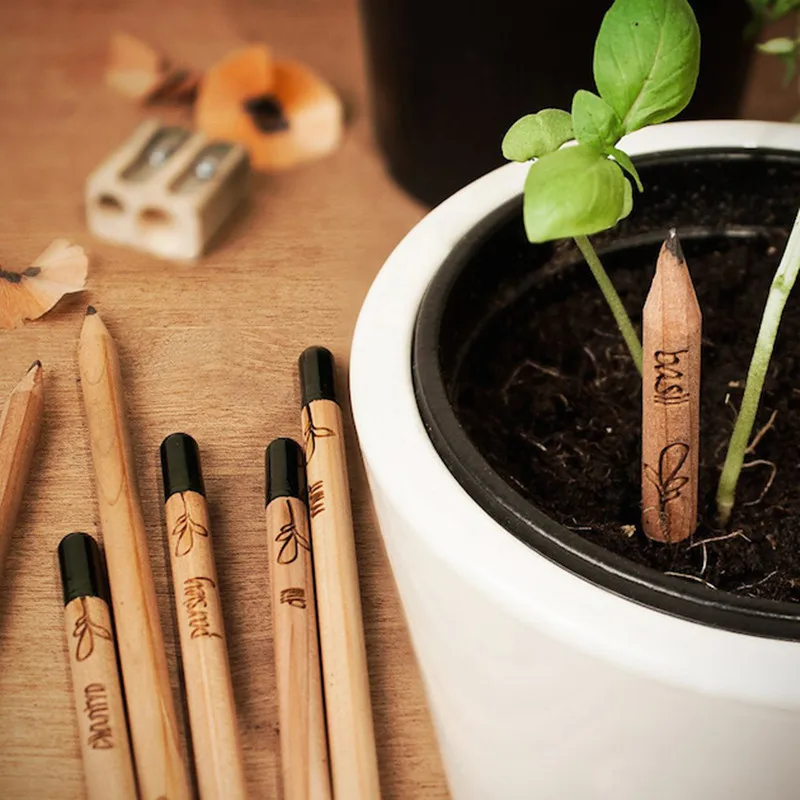
Pencil stubs when planted in a pot grows into a plant: flowering plant or a herb


Britain’s ‘MADE TO LAST’ is a company that makes utility items with at least 1 year warranty. Some of their items have a warranty period of 10 years! People shop on price to a large extent as it is easy to measure. The true value of a product however also depends on its life span. The made to last website allows you to shop by pricecategory and even by warranty. Manufacturers need to take responsibility for their product quality and asking them to account for the longevity of their products and description of the product source: organic or genetically modified (GMO) lets us make informed choices. Let us all join hands at demanding products that are sustainable and if you ever need help to break from ‘shop-a-hol-ism’ consider those four factors: cost, time, maintenance and space as antidote against purchase.

References
2.  Pappco: https://www.pappcoindia.com/
 3.  Bollant: http://www.bollant.com/
5.  Leaf republic: http://leaf-republic.com/


Thursday, November 5, 2015

The Universal bond


It is rather difficult to feel lonely in India. Not only because there are too many of us and one keeps bumping into one another, but also because there is a general bonhomie in the air that instantly helps you connect with others. Within weeks of coming back to India, I found myself effortlessly drawn into conversations with the local grocery guy, the maid, the security guard; sharing food with the assistants at the clinic, celebrating their birthdays; people who until recently I had no association with. It was not as if I was making any special attempts to socialize with them. It was happening by itself. I was unknowingly but surely entering into ‘undefined’ relationships with the others. It was not long before didi, tai, mausi, aunty, etc got suffixed to my name: I was automatically becoming part of some larger bond. In an attempt to decipher this bond, I came across a South African philosophy “Ubuntu”: the belief in a universal bond of sharing that connects all humanity". The following paragraphs are examples of different situations when I have felt a part of this universal bond.


Pune recently celebrated the 10 day long Ganpati Pooja.  Even if you are too busy to celebrate the euphoric atmosphere all around will gear you for celebrations. There is something for everyone: pooja and aarti for devotees, dhol tasha for youngsters,social skits performed at the Ganesh pandals for onlookers and curious people, lots of modak, loud music, decorations and rangoli and plenty of photo options. The excitement is palpable all around: sometimes in the form of loud speaker vibrations!  I loved the common energy during the ‘Ganesh visarjan’ procession. Despite the chaos and the noise, the pushing and shoving, numerous camera and selfie sticks, it gave me a momentary high!  It gave me a feeling of a community, even though I hardly knew anyone around me.

 A scene from Ganpati visarjan: Photo Credits: Apurva Thakur


I am sure many of us have been helped at some point in time by kindly strangers. One might meet them anywhere: while walking down a quiet street or a busy market place, while travelling in a train, bus or flight, while waiting in a queue. The other day my sister and I had lost our way:  as we were contemplating where to go, a passer-by noticed our dilemma, came up to us, asked where we wanted to go and guided us through the right route. A friend of mine once had to catch a connecting train with very little time for transfer from one to the other. One of the train pantry guys understood the situation and helped her to quickly transfer her luggage and catch the other train on time. But for his timely help, she would have missed her connecting train.

As a student I have traveled alone a lot, especially in trains. On most of these journeys, I have met some very friendly and interesting people from diverse backgrounds: a politician, a teacher, a wildlife conservationist and author, an animation artist, a television reporter are some that I remember. I don’t recall their names or the exact conversations, I may not even recognize them if they pass me by next time. What I do remember is sharing a nice time with them- over food, a few laughs and some games.  Some passengers have voluntarily watched over my luggage for safety while I got down a platform, others have offered to buy food when they were getting some for themselves.  A kind co passenger once shared his food with me when the trains’ pantry had reached its limit, some others have shared their seats if I have had a RAC (reservation against cancellation) or wait listed ticket.


There is a bond one shares with people who don’t really classify as friends or relatives but who we meet often: like the vegetable or grocery vendors we usually go to, the girls’ hostel mess boy, the security guards of work place or of one’s colony, the lift man, house maid  among many others. We don’t realize but they too have an important role in our lives. A small interaction with them can sometimes make our day. I remember feeling teary eyed when our hostel mess boy, “Raju anna” offered his share of food every time I got late to lunch and the Mess food had run out. I feel grateful when our local grocery guy, “Bhavani bhaiya” remembers our order, likes and dislikes and gives us suggestion on some popular items that are suited to our taste.  I sometimes take for granted when the dhobi bhaiya remembers to come an extra time to accommodate some last minute change in travel plans.  All the above are every day examples of people who often go unnoticed.

I am glad to be a part of so many different relationships, it is as if everywhere there is someone who is looking out for you, I feel safe, I feel cared for. It is the little things that make life big. These ‘nameless people’ we meet in day to day life are part of the “little things in life” .


Wednesday, August 19, 2015

Horn, ok, please!


I never feel alone in India, not even when skipping red lights :)  You may wonder what transpired to make a generally law abiding person to break the law. The deafening horn of multiple vehicles:motor bikes, scooties, auto rickshaws, cars, buses colluded to make me a law breaker.


The traffic scenario in all major cities is worsening world over, but in Pune it is doing so by leaps and bounds. I have been away for only 2 years and it seems skipping traffic signals has become a norm. It is not just the ubiquitous and multitudes of two wheelers that skip red lights, PMT (Pune Municipal board) buses do so too!!!


Just to give you an idea of what PMT buses look like here’s a picture

Honking is the unspoken language of everyone on the road. It is used to communicate a variety of emotions: to get you to speed up or to slow down, move to your left, sometimes right, take a pass, to break up a crowd of people who have decided to congregate in the middle of the road to chat up some, scare away the stray cows or dogs ambling away on the road undaunted, among many other emotions. Since it is such a common language, to grasp it entirely one has to supplement its understanding by some supporting observations. In case of two wheel drivers one may have to gauge their body language to guess what their next step maybe,  for PMT bus drivers, look out for their frustration level by how much squealing noise they make with their brakes (a tactic commonly employed to emote by many PMT bus drivers). Having a meek little bell is a big disadvantage for bicyclists who emote in the following way :


Having been sensitized in the USA and UK for the last 5 years where honking is considered disrespectful unless absolutely necessary, my husband refrains from honking here in India as well. It is just a matter of time before he re-learns that honking is not only necessary but mandatory to survive Pune traffic. As for me, I often feel like using Harry Potter’s charm “Silencio”. In Harry Potter lingo,   The Silencing Charm (Silencio) is a charm that renders the victim temporarily mute, working on both beasts and beings. Here though I want to modify the charm to use it on the vehicles and mute them instead.


Driving on the wrong side of the road, stopping anywhere without indication even though the roads are narrow and can easily slow down the ongoing traffic are some other road “mis- etiquettes” that can be very annoying.  If I have to look at it differently though, driving in Pune can be likened to a thrilling video gaming experience, in real life. It has definitely sharpened my reflexes! An American friend of mine who was briefly visiting India had remarked to me “traffic in India is like water, it finds its own way to flow”, a really astute observation!  Nothing can deter the traffic: be it large pot holes, water logging or a bus that has broken down in the middle of the road. There are traffic jams and bottlenecks often but people squeeze in and make room by going over the pavement, going over to the wrong side of the road, and not to leave out the most lethal weapon: persistent honking till the person in front gets annoyed and somehow makes room for you to pass, many a times by skipping the traffic light!

Its been 2 months since I wrote this blog and I would like to update some developments in dealing with persistent honking. I now have a helmet!! People use helmet to save their precious heads, my objective though is to use it for mitigation of noise :) Also having a headphone with music playing ( in one ear) helps me enjoy music while I ride. This is serving me quite well, I am glad to say that I am now fully adjusted in :)
Steps in getting ready for a ride:
Step 1: switch on the music and plug your ear phone in one ear
Step 2: Wrap your scarp around your head, taking care the head phone is still in place
Step 3: Wear your helmet on top of all this

Now we are set to take on the noisy traffic with an elan ;)

Wednesday, July 1, 2015

Learn, Unlearn, Relearn


We are back to India after 2 years of  our stay in the USA.  A lot seems to have changed while we were away.  As we grapple with the substantial context switch from bay area to Pune, I muse: Even though air travel and other technology has made life faster, ‘adapting’ is still a function of psychology and biology, it takes its own time!

Suddenly it all feels so cramped. Houses look unkempt, roads look narrow, driving on the left side of the lane seems abnormal, people seem far too many…. things I maybe never noticed earlier are now an eyesore. The personal interaction I yearned for in the USA now seems intrusive. When we went to get the sim card for a new phone number the sales guy began asking me: “How much do you talk on phone, how much data do you use, do you text often?” These are routine questions, but to me it seemed like an interrogation. I had grown accustomed to being shown brochures of the choices available and then selecting an option, rather than give out details about my phone usage to a stranger. Has it really been just two years? I hope this dissonance ends soon.

I was always a planner, but the unpredictability of India kept it in check:there were always myriad contingencies that could not be planned for. In USA everything worked seamlessly with clockwork precision and predictability. In such a system one cannot blame anyone/anything except oneself  for a plan not working out well. This increased my ownership and unleashed the ‘monster planner’ in me. My husband had started calling me a control freak. I wanted to know everything upfront. For example if we were planning an outing to San Francisco I would plan for: what time should we start from home to be able to get a parking spot, where to park, what to do if that parking spot was full, what if we have to park really far, what mode of public transport would reach us to our destination, would it be cost effective, and on and on and on. There was hardly any spontaneity left. The fact of the matter was that most plans worked well! I would get a huge rush every time this happened, it fueled my obsessiveness.  It was turning me into a perfectionist, somewhat intolerant and impatient. The uncertainty of India is humbling and a welcome reminder to let off control from self to the unknown. I am re- learning to be spontaneous again,to keep faith, to believe in higher power and let things be, to say "so what" if things don't work according to plan.


USA had made me so independent, or rather device dependent.  If you want something- look up the internet, find the best choice from reviews, find the stores in which it is available and go buy that exact thing. Here in India everyone has recommendations: do this, buy that, go there,etc. You get so much advise at the drop of a hat! A skill now required is to be able to listen and filter necessary information, to stand your ground, and then make a choice. All this without losing your temper. Its challenging but I am working at it :)

In a fast changing global world, the ability to not only learn but also unlearn the earlier learnt behavior, as well as relearn a previously forgotten skill are mandatory for survival. This is a measure of adaptability . As Charles Darwin quotes “It is not the strongest of the species that survive, nor the most intelligent, but the one most responsive to change.”

Quote from the sunscreen song “ Live in northern California but move out of it before it makes you too soft. Live in New York City but move out of it before it makes you too harsh’’
Keep moving, keep adapting, keep growing!

The sunscreen song: